How to get a job using LinkedIn?
An evidence-based guide to turning LinkedIn into a job search system: profile, alerts, companies, networking, applications, and follow-up.

Getting a job using LinkedIn requires combining four tasks: defining the position we are looking for, presenting evidence that we can perform it, finding relevant opportunities, and talking with people who know that market. LinkedIn can increase our visibility and bring us closer to vacancies, recruiters, and contacts; it does not replace skills, an adapted resume, or a selection process. The useful strategy does not consist of clicking 'Easy Apply' hundreds of times. It consists of building a weekly system that produces relevant opportunities, careful applications, professional conversations, and learning.
What can LinkedIn do — and not do — for a job search?
LinkedIn serves at the same time as a professional profile, a job search engine, and a network of relationships. This combination allows a person to find jobs and a recruiter to discover them. The platform itself explains that its recommendations consider the profile, searches, alerts, activity, and job preferences. Therefore, completing those elements helps communicate intention; it does not guarantee appearing first or receiving an offer.
The evidence invites us to avoid extremes. Nikolaou (2014), in two surveys conducted in Greece, observed that job portals were still used more than professional social networks, although human resources specialists valued LinkedIn as a recruiting tool. The practical conclusion is to use LinkedIn as part of a multichannel search, not as the only path.
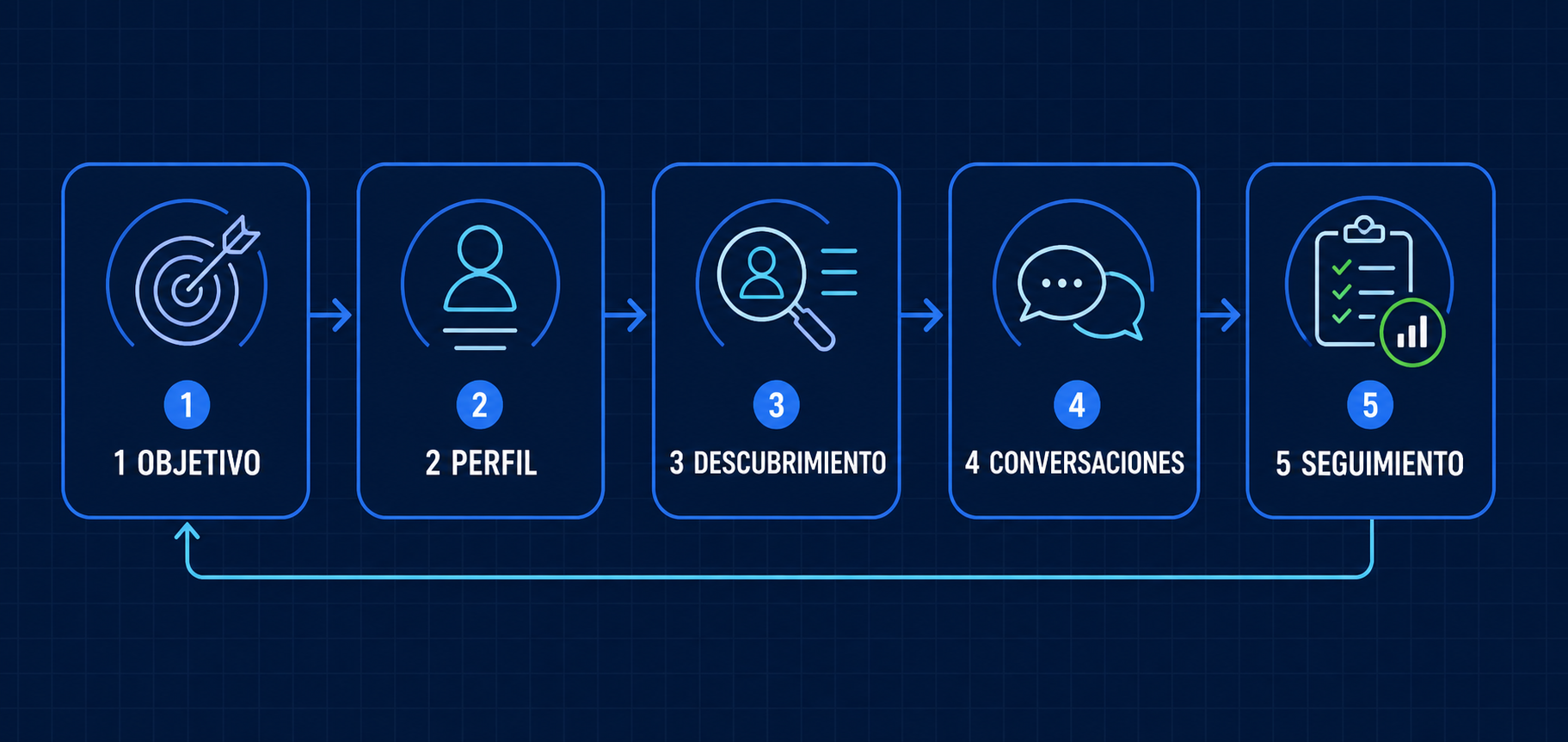
Figure 1. A five-stage system for turning activity into learning and opportunities.
Source: own elaboration based on LinkedIn (2026), Van Hoye et al. (2009), and Rajkumar et al. (2022).
1. How to define the job we are really looking for?
A precise search begins with a hypothesis, not with the phrase 'I'm looking for any job.' It is advisable to choose one or two closely related positions, possible sectors, location or modality, level of responsibility, and three capabilities that we can demonstrate. This definition will guide the headline, the words used in the profile, the alerts, and the companies we follow.
We can write a brief summary: 'I am looking for a [position] at [type of organization], where I can contribute [capabilities] and demonstrate it through [results or projects].' Then we should compare it with ten real openings. If the requirements repeat, we will have market vocabulary; if our experience does not cover a central condition, we can adjust the objective or prepare additional evidence.
2. How to turn the profile into a verifiable application?
The profile should allow someone to understand in seconds what we do and find evidence. The headline can combine target position, specialty, and context. The About section should summarize contribution, experience, and next step. In each job, it is advisable to explain scope, action, and result, without inventing numbers. Featured can bring together relevant projects, articles, portfolio, or presentations.
Chiang and Suen (2015) found that the quality of self-presentation arguments in LinkedIn profiles was related to perceptions of person-job and person-organization fit, which in turn influenced hiring recommendations. Roulin and Levashina (2019) showed that certain aspects of competencies could be evaluated with acceptable consistency from profiles, especially using structured criteria. This does not turn the profile into a definitive test: it reinforces the need to show specific and organized signals.
For a section-by-section review, see our complementary guide: https://strateria.app/en/blog/como-optimizar-perfil-linkedin. The central rule is simple: every important claim needs context or evidence.
3. What preferences and alerts should be configured?
LinkedIn recommends activating alerts based on searches, preferences, and specific companies. It also allows you to save jobs and keep several versions of your resume for different descriptions. A minimum configuration includes positions, locations, modality, job type, and notification frequency. It is better to maintain a few well-defined alerts than to receive dozens of irrelevant results.
The Open to Work feature allows you to indicate titles, locations, start date, and job types. It can be shown to your entire network or only to LinkedIn Recruiter users. LinkedIn warns that it tries to hide that signal from recruiters at your current company, but it does not guarantee complete privacy. Each person must decide visibility based on their employment situation.
4. How to search for jobs and companies with intention?
The search does not end in the Jobs tab. LinkedIn allows you to use keywords or conversational language and filter results. It is advisable to combine position, specialty, sector, and location; save openings that deserve analysis; and follow the pages of twenty target organizations. Reviewing their posts helps you understand priorities, projects, and language before applying.
For each opportunity, compare requirements with evidence. Classify fit as high, medium, or low. A high-fit application deserves an adapted resume, profile review, and a contextual message. A low-fit one may only serve to discover a skill the market demands. This selection avoids confusing volume with progress.
5. How to use the network without asking strangers for a job?
Networking means seeking information, context, and bridges; not requesting a recommendation in the first message. We can start with former colleagues, clients, teachers, suppliers, and people we know from events. A useful message identifies the relationship or common interest, asks a specific question, and allows the person to respond without pressure.
Van Hoye, Van Hooft, and Lievens (2009) longitudinally studied 1,177 unemployed people. Networking explained additional variation in offers received compared with other methods, although it did not by itself predict the final employment outcome. Rajkumar et al. (2022), through large-scale experiments on LinkedIn, provided causal evidence that moderately weak ties can facilitate job mobility; the effect does not mean that the more distant a contact is, the better.
A reasonable practice is to maintain five weekly conversations: two with existing relationships, two with people from target teams or sectors, and one with someone who can broaden the map. Ask about role challenges, valued capabilities, and real processes. Then thank them and share something useful.
6. How to apply with quality and follow up?
Before sending an application, adapt the resume summary and organize evidence according to actual requirements, without copying sentences or adding nonexistent skills. Verify instructions, date, location, and company. LinkedIn advises researching organizations and recognizing possible fraud; a vacancy should lead to a verifiable corporate identity and never require payments to be hired.
Record date, position, link, resume version, contact, and next action. If there is a legitimate relationship with someone at the organization, we can let them know we applied and explain the fit in two sentences. Follow-up should not become daily insistence: a contextual and respectful note is usually enough.
Table 1. Weekly LinkedIn job search system.
| Stage | Minimum weekly action | Evidence of progress | Signal to adjust |
|---|---|---|---|
| Objective | Review 10 comparable openings | Requirement patterns | Positions too scattered |
| Profile | Improve one section or piece of evidence | Profile consistent with objective | Messages unrelated to the role |
| Discovery | Maintain 3–5 precise alerts | High-fit openings | Excess of irrelevant results |
| Relationships | Sustain 5 useful conversations | Information, bridges, or referrals | Messages without responses or context |
| Application | Send 3–5 careful applications | Interviews or stage advances | Many applications, no conversations |
Source: own elaboration based on LinkedIn (2026), Van Hoye et al. (2009), and Van Hoye and Saks (2008).
What mistakes reduce the chances of getting a job?
The most frequent mistakes form a pattern: activity without direction. They include applying for incompatible positions, using a generic headline, describing tasks without results, sending invitations without context, asking for recommendations from people who do not know your work, and abandoning follow-up. Exaggerating also hurts. A public profile can be checked against colleagues, dates, projects, and other sources.
Another mistake is measuring only the applications sent. That number does not show whether we chose well or where the process breaks down. We need to distinguish initial indicators —relevant openings, conversations, and quality applications— from results —responses, interviews, offers, and acceptance.
How to know if the strategy is working?
Review the system every two weeks. If almost no vacancy fits, we should redefine the objective or close a gap. If there are profile visits but no messages, review clarity and evidence. If we receive responses but no interviews, evaluate the resume and fit. If we get interviews without advancing, the priority is no longer LinkedIn but better preparing examples and selection conversations.
Do not attribute an offer to a single change without evidence. LinkedIn facilitates discovery, relationships, and application; hiring also depends on the market, competition, evaluation, and organizational decisions. Measuring stages allows us to learn without turning every silence into a personal judgment.
Conclusion: LinkedIn works best as a system, not as a shortcut
Getting a job using LinkedIn is more likely when the profile, the search, the network, and the applications point to the same objective. First we define the position and verify its language in real openings. Then we organize the profile around evidence, configure preferences and alerts, select companies, and talk with people who can provide context. Finally, we apply with quality and record what happened.
The platform can help us be found and discover opportunities that were not in our immediate circle. It cannot promise a hire or compensate for an incoherent application. The advantage lies in making the process observable: each week leaves analyzed openings, better-presented evidence, cared-for relationships, and informed decisions. That way LinkedIn stops being a place to wait and becomes a professional search tool with method.
References
Chiang, J. K.-H., & Suen, H.-Y. (2015). Self-presentation and hiring recommendations in online communities: Lessons from LinkedIn. Computers in Human Behavior, 48, 516–524. https://www.sciencedirect.com/science/article/pii/S0747563215001156
LinkedIn. (2026). Find jobs on LinkedIn – Best Practices. LinkedIn Help. https://www.linkedin.com/help/linkedin/answer/a509393
LinkedIn. (2026). Let recruiters know you’re Open to Work. LinkedIn Help. https://www.linkedin.com/help/linkedin/answer/a507508/sharing-career-interests-with-recruiters-using-the-open-candidates-feature-overview
LinkedIn. (2026). LinkedIn relevance – Optimizing the member experience. LinkedIn Help. https://www.linkedin.com/help/linkedin/answer/a1339724
Nikolaou, I. (2014). Social networking web sites in job search and employee recruitment. International Journal of Selection and Assessment, 22(2), 179–189. https://onlinelibrary.wiley.com/doi/10.1111/ijsa.12067
Rajkumar, K., Saint-Jacques, G., Bojinov, I., Brynjolfsson, E., & Aral, S. (2022). A causal test of the strength of weak ties. Science, 377(6612), 1304–1310. https://www.science.org/doi/10.1126/science.abl4476
Roulin, N., & Levashina, J. (2019). LinkedIn as a new selection method: Psychometric properties and assessment approach. Personnel Psychology, 72(2), 187–211. https://onlinelibrary.wiley.com/doi/abs/10.1111/peps.12296
Van Hoye, G., & Saks, A. M. (2008). Job search as goal-directed behavior: Objectives and methods. Journal of Vocational Behavior, 73(3), 358–367. https://www.sciencedirect.com/science/article/pii/S0001879108000638
Van Hoye, G., Van Hooft, E. A. J., & Lievens, F. (2009). Networking as a job search behaviour: A social network perspective. Journal of Occupational and Organizational Psychology, 82(3), 661–682. https://repub.eur.nl/pub/19625
From reflection to strategy
Turn this idea into action
LinkedIn cannot guarantee a job, but it can help you make your experience visible, demonstrate sound judgment, and take part in relevant professional conversations. Strateria was created to support that process through consistent, organized communication, without replacing the quality of your track record or each application.
Create my free account Free access · No credit card