How to optimize your LinkedIn profile?
An evidence-based guide to turning your LinkedIn profile into a clear, findable, credible, opportunity-oriented professional presence.
Optimizing a LinkedIn profile means helping the right person find us, understand in a few seconds what we offer, verify it against evidence, and know what the next step is. It is not about filling every space or repeating keywords. A good profile connects goal, professional identity, proof, and a clear invitation to talk.
What does optimizing a LinkedIn profile mean?
An optimized profile is not necessarily the longest or flashiest. It is the one that reduces important questions: Who is this person? What problems do they know how to solve? For whom? With what results? And how can I see more of their work? LinkedIn (2026) describes the profile as a professional page for managing personal brand and recommends keeping it complete, representative, and up to date.
The research adds a caveat. A profile also produces inferences that we do not fully control. Van de Ven et al. (2017), based on two studies with 275 profiles, found that observers could infer extraversion and self-presentation to some degree, but not all personality traits consistently. That is why optimizing does not mean designing a persona; it means removing ambiguity without promising more than the track record can support.
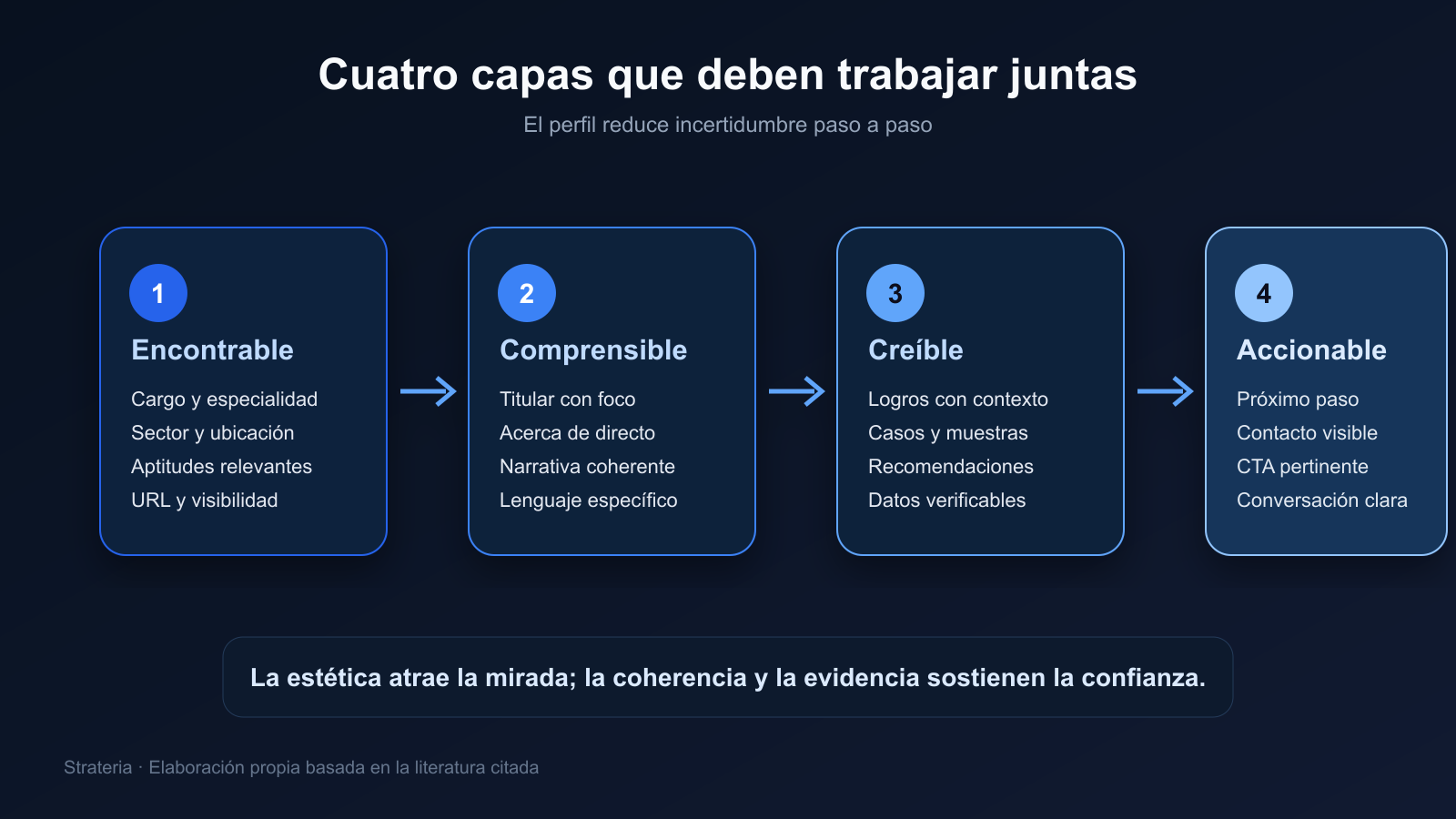
Figure 1. The four layers of an optimized LinkedIn profile.
Source: own elaboration based on LinkedIn (2026), Chiang and Suen (2015), Roulin and Levashina (2019), and Zide et al. (2014).
1. What is the profile's goal and who must it convince?
Before rewriting a single line, choose the main outcome. A job seeker, a consultant who wants to attract clients, and a person aiming for executive positions do not need the same profile. The evidence also changes: in recruitment, competencies and fit with the position matter; in professional services, solved problems, cases, and the confidence to start a conversation matter.
Let's write a working sentence: 'I want [audience] to recognize me as [specialty] and contact me for [opportunity].' Then select five to ten expressions that audience would use naturally: jobs, specialties, sectors, tools, or problems. These are not words to repeat mechanically but a vocabulary that must match real experience.
Caers and Castelyns (2011) observed that recruitment professionals already used LinkedIn to search for candidates, gather additional information, and decide whom to interview. Zide, Elman, and Shahani-Denning (2014) also showed that self-presentation varies across occupations. The practical conclusion is simple: the profile should be relevant to a specific audience, not generically 'professional'.
2. How should photo, banner, and headline work together?
The top of the profile should communicate one idea. The photo helps people recognize the person; the banner provides context; and the headline explains professional position. LinkedIn reports that members with a photo receive up to twice as many profile views, although this figure is the platform's own observation and does not by itself prove that the photo causes the increase.
The headline improves when it stops being just a job title. A useful structure is: specialty + problem or audience + way of providing value. For example, 'Sales Director' identifies a position; 'B2B Sales Leadership | Designing consultative selling systems for growing teams' makes field, context, and contribution understandable. It should sound human and be true: it does not need to become an ad.
The banner can reinforce the sector, a work idea, or a visual sample, without repeating the entire headline. Photo, banner, and headline need coherence. If each piece communicates a different identity, the visitor will have to decide which to believe.
3. How to write an About section that people finish reading?
The About section should answer first and explain afterwards. In the first lines, say what we do, for whom, and what kind of result we help produce. Then we can add experience, method, evidence, and a concrete invitation. LinkedIn recommends expressing mission, motivation, and skills in one or two paragraphs; that brevity forces prioritization.
A practical sequence contains four moves:
- Context: the professional problem we know well.
- Proposal: how we contribute and for which audience.
- Evidence: results, projects, sectors, or verifiable experience.
- Action: the conversation, collaboration, or opportunity we are willing to explore.
Chiang and Suen (2015) found that quality of arguments and source credibility in LinkedIn profiles were related to perceptions of fit and, through them, hiring recommendations. The About section gains strength not by accumulating adjectives but by connecting claims and evidence. 'Strategic leader' is a label; explaining a decision, its context, and its outcome provides an argument.
4. How to turn experience into evidence?
Experience should show contributions, not copy a job description. For each professional stage, select responsibilities that explain scope and two or three achievements with context. A reasonable formula is: situation + action + result + learning. If a piece of data is confidential, we can use a proportion, an authorized range, or a precise qualitative description; never invent a figure.
Roulin and Levashina (2019) found that evaluators could reach acceptable consistency when assessing certain competencies from LinkedIn profiles. They also observed that longer profiles with a photo and more connections received more positive evaluations, but that does not make length or number of contacts independent goals. The same study found that criterion-based evaluation was more effective than global impression. For the person building the profile, the lesson is to show concrete and ordered signals.
Table 1. Role of the profile's main sections.
| Section | Question it should answer | Priority improvement | Useful evidence |
|---|---|---|---|
| Photo and banner | Who am I seeing and in what professional context? | Current, recognizable, and coherent image | Identity and field of work |
| Headline | What do they do and for whom? | Specialty, audience, and contribution | Terms consistent with the track record |
| About | Why should I keep reading? | Direct answer, method, and next step | Results, sectors, experience |
| Experience | What have they really done? | Contextualized achievements, not a list of tasks | Projects, scope, results |
| Featured | Where can I verify it? | Select a few relevant samples | Cases, articles, portfolio, interviews |
| Skills and recommendations | What do others recognize? | Prioritize competencies and specific testimonials | Relevant external validation |
Source: own synthesis of LinkedIn (2026), Chiang and Suen (2015), Roulin and Levashina (2019), and Zide et al. (2014).
5. What evidence should be placed in Featured, skills, and recommendations?
The Featured section works as a brief portfolio. It does not need to gather everything published. Choose three to five pieces that support the current positioning: a case, a solid article, a presentation, an interview, or a service page. Each item should answer a question the profile has already raised.
Skills should reflect the work we do and the work we want to do. LinkedIn indicates that relevant skills help show strengths and can increase the chance of being discovered for related opportunities. Prioritizing them requires distinguishing core competencies, tools, and transferable capabilities; a huge, disorganized list reduces clarity.
Recommendations gain value when they identify the relationship, the challenge, the behavior, and the observed effect. Rui (2018), in an experiment with 156 participants, found that recommendations from former supervisors were more expected and evaluated more positively than those from subordinates, while reciprocal recommendations received less favorable evaluations. This does not mean only a boss can recommend; it means independence and context matter.
6. How to improve visibility without filling the profile with keywords?
To appear in searches, we need to use the language the audience recognizes. Include relevant terms, when they are true, in the headline, About, experience, and skills. Keep the same name for a specialty or tool; that way a person and a search system can connect the pieces.
LinkedIn advises against artificially repeating keywords, inflating experience or education, and turning the personal profile into advertising. A safer strategy is to cover related concepts: role, sector, problem, method, tool, and result. It is also useful to customize the public URL, review profile visibility, and add contact information we are willing to make public.
Accuracy protects reputation. Guillory and Hancock (2012) showed that LinkedIn's public nature changes patterns of deception compared to a private résumé: social verifiability reduces some exaggerations, but can shift others. Optimizing is presenting the truth better, not decorating a nonexistent track record.
7. How to audit the profile in thirty minutes?
A short audit should look at the whole journey, not correct isolated phrases. Open the profile in a private window, view it as someone who does not know us would, and answer questions in order.
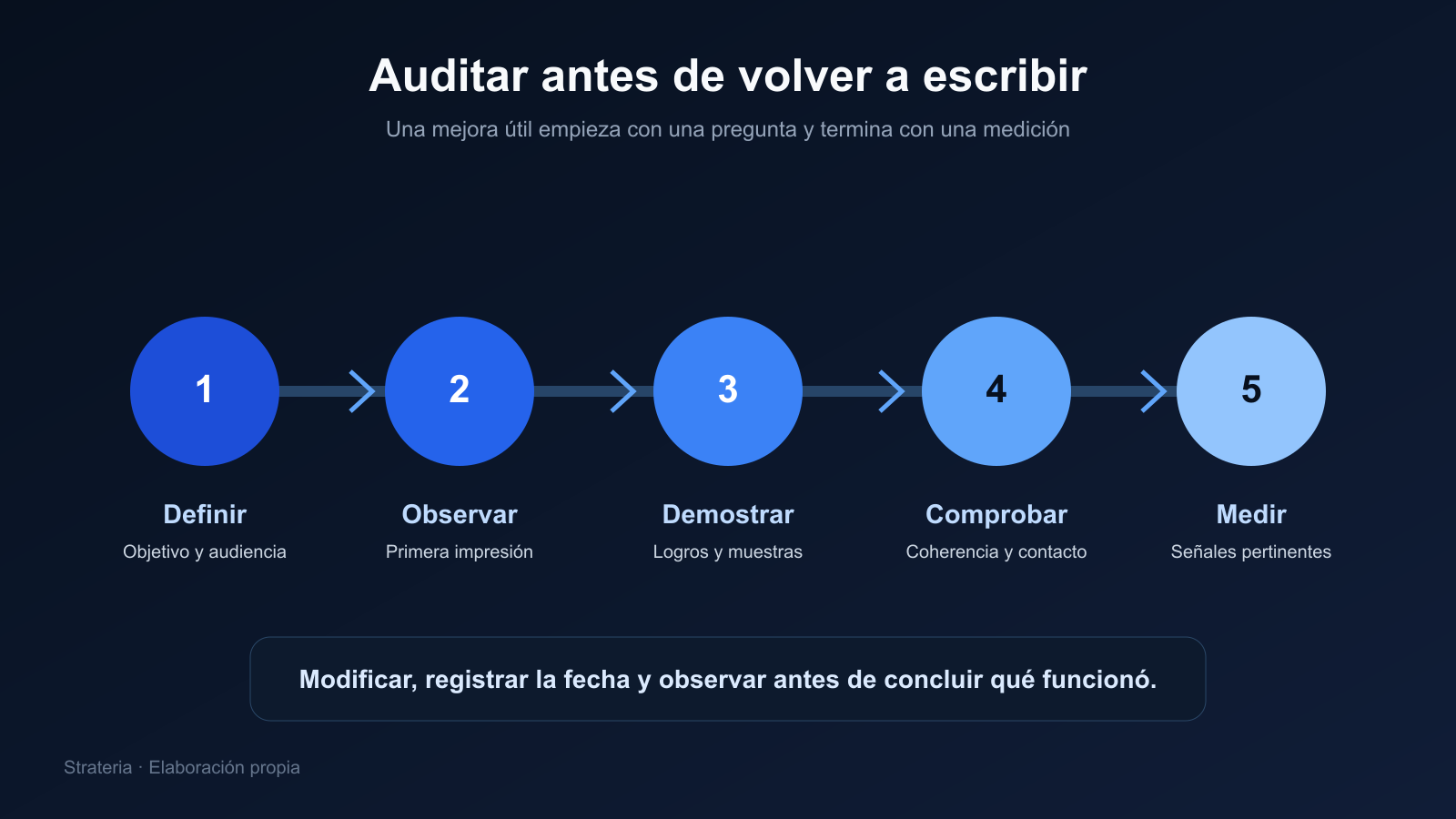
Figure 2. Audit route for moving from goal to verifiable improvement.
Source: own elaboration based on the cited literature and documentation.
Table 2. Practical thirty-minute audit.
| Time | Review | Control question | Expected result |
|---|---|---|---|
| 0–5 min | Goal and audience | Is it clear who the profile exists for? | A positioning sentence |
| 5–10 min | First screen | Do photo, banner, and headline tell the same story? | Understandable identity |
| 10–17 min | About and experience | Does every important claim have context or evidence? | Fewer adjectives, more evidence |
| 17–23 min | Featured and validation | Do the samples, skills, and recommendations support the focus? | Relevant proof |
| 23–27 min | Discovery | Do the relevant terms appear naturally? | Consistent language, no repetition |
| 27–30 min | Next step | Does the visitor know how and why to contact us? | Appropriate CTA and contact |
Source: own elaboration.
After applying changes, note the date and observe for several weeks relevant views, search appearances, qualified messages, invitations, or conversations. Do not attribute a result to a single edit without evidence. Optimization is a hypothesis to be reviewed, not a definitive ritual.
Conclusion: a useful profile reduces uncertainty
The best question is not 'How do I make my profile impressive?' but 'What does the right person need to understand and verify?' An optimized profile makes it easy to find a specialty, understand a contribution, review evidence, and start a conversation. Aesthetics help; clarity guides; evidence sustains trust.
Order also matters. First define goal and audience. Then align headline, About, and experience. Finally incorporate samples, skills, recommendations, and a next step. When all sections support the same verifiable promise, LinkedIn stops being an accumulated résumé and becomes a professional page that works with intention.
References
Caers, R., & Castelyns, V. (2011). LinkedIn and Facebook in Belgium: The influences and biases of social network sites in recruitment and selection procedures. Social Science Computer Review, 29(4), 437–448. https://doi.org/10.1177/0894439310386567
Chiang, J. K.-H., & Suen, H.-Y. (2015). Self-presentation and hiring recommendations in online communities: Lessons from LinkedIn. Computers in Human Behavior, 48, 516–524. https://doi.org/10.1016/j.chb.2015.02.017
Guillory, J., & Hancock, J. T. (2012). The effect of LinkedIn on deception in resumes. Cyberpsychology, Behavior, and Social Networking, 15(3), 135–140. https://doi.org/10.1089/cyber.2011.0389
LinkedIn. (2026). Create a good LinkedIn profile. LinkedIn Help. https://www.linkedin.com/help/linkedin/answer/a548467/
LinkedIn. (n.d.). Practices you should avoid when optimizing your profile for LinkedIn search. LinkedIn Help. https://www.linkedin.com/help/linkedin/answer/a525117
Roulin, N., & Levashina, J. (2019). LinkedIn as a new selection method: Psychometric properties and assessment approach. Personnel Psychology, 72(2), 187–211. https://doi.org/10.1111/peps.12296
Rui, J. R. (2018). Objective evaluation or collective self-presentation: What people expect of LinkedIn recommendations. Computers in Human Behavior, 89, 121–128. https://doi.org/10.1016/j.chb.2018.07.025
van de Ven, N., Bogaert, A., Serlie, A., Brandt, M. J., & Denissen, J. J. A. (2017). Personality perception based on LinkedIn profiles. Journal of Managerial Psychology, 32(6), 418–429. https://doi.org/10.1108/JMP-07-2016-0220
Zide, J., Elman, B., & Shahani-Denning, C. (2014). LinkedIn and recruitment: How profiles differ across occupations. Employee Relations, 36(5), 583–604. https://doi.org/10.1108/ER-07-2013-0086
From reflection to strategy
Turn this idea into action
A clear profile allows others to understand what you can do; a content strategy demonstrates that value over time. Strateria was created to connect these two tasks and help you turn your positioning into messages, posts, and a more coherent professional presence.
Create my free account Free access · No credit card